Serving London & the surrounding area.
EMAIL US
info@fceavestrough.com
CALL US
(548) 488-3206
HOURS
MON - FRI 8AM - 7PM

The short answer
Horizontal lap siding suits most traditional London homes: two-storeys, older brick houses and anything with a classic roofline. Vertical board and batten suits raised bungalows, modern builds and accent areas like gables. Haven insulated siding adds a wider, flatter board with foam behind it. Mixing profiles often looks best, with lap on the walls and vertical accents.
A profile is the shape of a siding panel: which way it runs, how many boards each panel shows, and how tall each board looks once it is on the wall. The names describe that last part. “Double 4” means each panel is made to look like two boards, each showing 4 inches. “Triple 3” looks like three boards of 3 inches. That visible height is called the exposure.
Exposure is the biggest thing that changes how a lap-sided house looks from the street. A narrow exposure gives you more lines on the wall, which reads busier and more traditional. A wider exposure gives fewer, bolder lines, which reads calmer and a little more modern. Neither is better. It depends on the house.
Vertical siding is named differently because it runs the other way. Board and batten is a wide flat board with a narrow raised strip, the batten, covering each joint. The strips throw a shadow down the wall, and that shadow is what gives the style its look.
We install Royal Building Products siding, and every profile here is named the way Royal names it. “Residential”, “Board & Batten” and “Haven” are Royal product lines, not general terms.
We install three Royal lines most: Royal Residential, which is horizontal lap, Royal Board & Batten, which is vertical, and Haven Insulated Siding, which has foam insulation bonded to the back of a wider panel.
| Royal line | Look | Profiles, as Royal names them | Suits |
|---|---|---|---|
| Royal Residential | Horizontal lap, low-gloss cedar woodgrain | Triple 3”, Double 4”, Double 4.5”, Double 4.5” Designer | Two-storeys, older homes, traditional rooflines |
| Royal Board & Batten | Vertical, with taller 5/8” battens | 5 1/2” Vertical Board & Batten | Raised bungalows, modern builds, gables and accents |
| Haven Insulated Siding | Wider, flatter panel, deep woodgrain | Double 6” Traditional, Double 7” Traditional, Board & Batten | Homeowners who want a wider board and the insulation |
Royal Residential is the least expensive of the three. Board and batten costs more, and Haven costs more again. Other styles are possible if you have something specific in mind, and there is a picture of each of the three on our page for vinyl siding installation in London.
Lap siding suits almost any house with a traditional shape: a two-storey with a pitched roof, an older home in Old South or Old North, a storey-and-a-half, or a brick house getting siding on its upper floor or gables. It rarely looks out of place on a street of older homes.
Royal Residential comes in four profiles, and the choice between them is mostly about exposure.
Royal describes the finish as a low-gloss woodgrain that looks like natural wood.
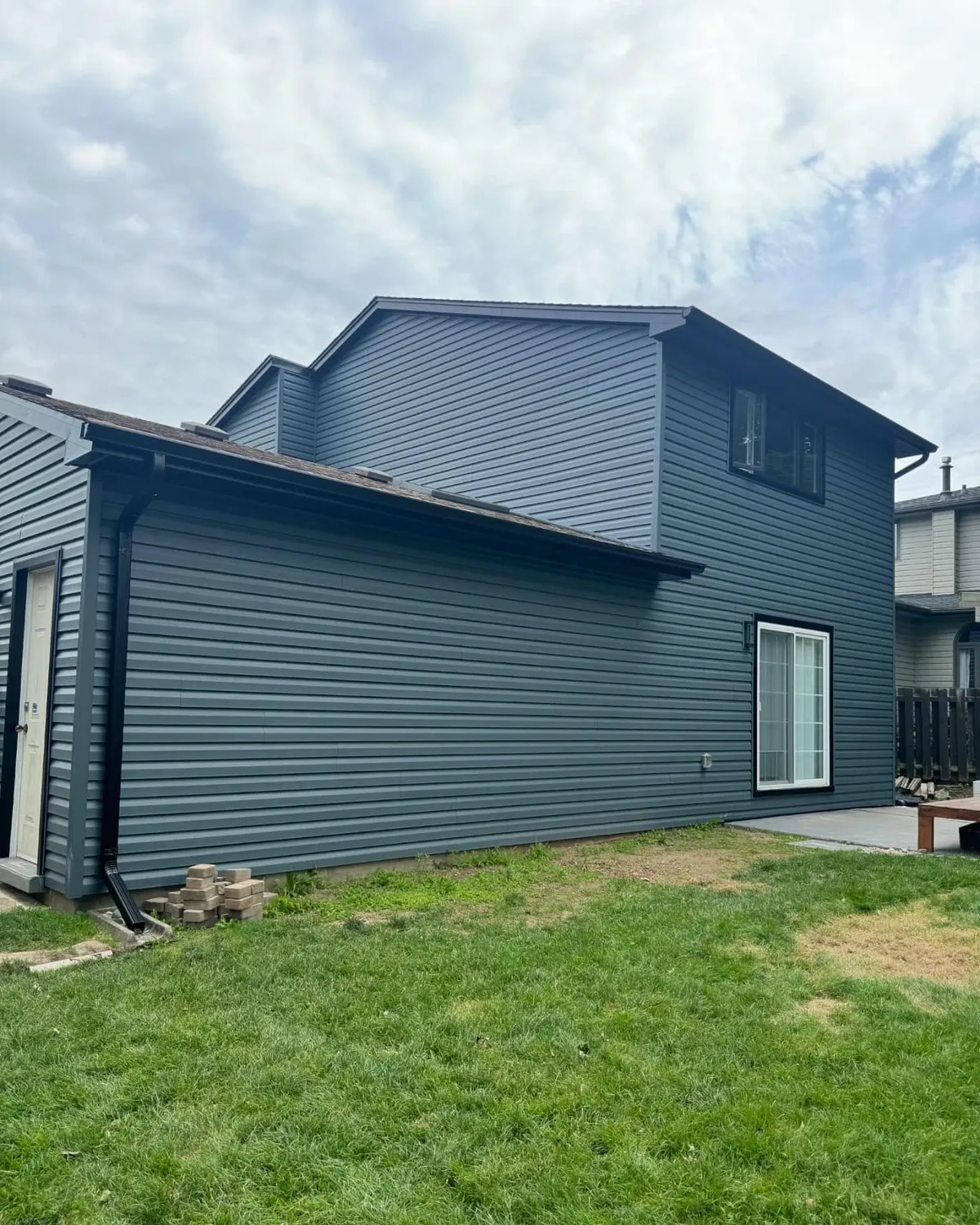
The bigger the wall, the more the exposure matters. On a single-storey side wall, the difference between a 3-inch and a 4.5-inch board is subtle. On a tall two-storey gable end, it changes the face of the house.
Board and batten suits houses with simple, strong shapes: raised bungalows and split-levels, newer builds, modern farmhouse styles, and any home where you want the siding to look deliberate rather than background. The vertical lines also make a wall look taller, which helps a low, wide house.
Royal Board & Batten has one profile, a 5 1/2-inch board. Royal says its taller 5/8-inch battens give sharper, deeper shadow lines, and that shadow is the reason to choose it. On a sunny afternoon the battens draw clean dark lines down the wall.
It works especially well on a raised bungalow or split-level with brick on the lower half. The vertical siding sits on top of the brick and makes a clear break between the two, instead of horizontal lines running into horizontal brick courses. The photo at the top of this guide is that exact setup.
On a very traditional two-storey with lots of trim and detail, board and batten can fight the house. There, we would usually keep it to the gables or an entry.
Both. Royal lists three Haven profiles: Double 6” Traditional and Double 7” Traditional, which are horizontal lap, and a Board & Batten. Those lap profiles show a 6- or 7-inch board, wider than anything in Royal Residential, and the panel face is flatter, with a deep woodgrain. On a big wall, that gives a broad, clean look narrow lap siding cannot.
The foam is the other half. Royal says it reduces thermal bridging, which is heat escaping through the wood studs in your walls, while still letting water vapour from inside the house escape. Royal also says it enhances sound deadening and impact resistance. How much that matters depends on your home, and we will be honest about it when we look.
Haven also comes in a shorter list of colours than board and batten, so if you have a colour in mind, tell us before you settle on the profile.
Yes, and on a lot of London homes a mix looks better than one profile everywhere. A common pairing is lap siding on the main walls with vertical board and batten as an accent: in the gables, over a front entry, on a bump-out, or around the windows on the front face.
A few rules keep a mix looking intentional:
The space over windows and in gables is often where older homes carry decorative trim that has had its day, and replacing it is one of the simplest ways to update a front. One customer described exactly that in her Google review: “They replaced the outdated gingerbread siding over our windows and removed and replaced out aging eaves(height was obviously not an issue for them) We are in love with the look.” (April McTaggart) If your eavestrough is as old as your siding, it is worth deciding whether to repair or replace your eavestrough at the same time.
The best design advice for your house is usually a short walk. Look at homes built around the same time as yours, with the same roofline, and notice what looks right on them.
Look at the same houses at different times of day if you can. Board and batten in particular changes with the light, because so much of its look is shadow.
Then look at your own house from across the street, not from the driveway. That is the view everyone else gets. You can also see finished siding jobs on homes around London before you decide.
Time, first. Siding takes longer than an eavestrough job: depending on the house and material lead times, it can run from a few days to a week.
Then the roof edge. Siding, eavestrough and the soffit and fascia all meet there, so if any of them is tired, the siding job is the time to deal with it, finished together and matched in colour.
If you have noticed soft or stained board along that edge, read the signs of rotted fascia and soffit before your quote.
If the fascia is old wood, our guide on whether to go with a fascia wrap or replace the wood fascia covers that decision.
Every install comes with our 10-year workmanship warranty, the same one that covers our seamless eavestrough, and siding products also carry the applicable manufacturer warranty. We will go through the details of both when we quote.
Royal Residential, the horizontal lap line, is the least expensive of the three we install. Royal Board & Batten costs more, and Haven insulated siding costs more again. The difference depends on your house, so the only real number is a quote.
Yes. We bring samples to the quote, and if you need longer to decide, we can leave them with you so you can see them against your brick and roof in your own light. We pick them up afterwards.
No. Colours vary by siding line. The palette on our siding page is the Royal Board & Batten range, and Royal Residential and Haven each come in a shorter list. Tell us the colour you want and we will confirm which profiles it comes in when we quote.
Yes. We will look at your house with you, show you samples and tell you which profile we would pick and why. The quote is free. Ask for one through our contact page.
Keep reading


Straight from Google reviews
4.9127 reviews on Google
Read all 127 on Google“Good pricing and great services.”
“Great work! Tibor and Connor did an amazing job. Both were able to answer any concerns. Both very professional. I would highly recommend using Forest City Eavestrough 👌 👍”
“I was extremely impressed with the level of communication, professional information and exceptional work ethic displayed by this team. Work was completed on time and with efficiency. … Definitely would recommend this company and would call them again for any other work.”
“Forest City Eavestrough did a great job replacing our eavestroughs. Tibor gave us a great price, the work was completed in one day … and most importantly, the eavestroughs are functioning perfectly now. Thanks so much!”
“highly Recommend this company, had my eavestroughs replaced and they did a great job!”
“Very happy with the service this team provided. Good pricing, fast service, very responsive. Will definitely hire them again for future jobs.”
“Fantastic experience for us from start to finish! Would highly recommend Forest City Eavestrough to anyone seeking this service.”
“What's an amazing company and crew super fast I called them next day they did all my siding and eavestrough my house looks amazing thanks guys definitely recommend number 1 company thanks again guys”
“I got some eavestrough replaced Excellent work. Great price. Perfect corners,Very easy to deal with and the guys where on time and I had no mess to clean up”
“Kind, considerate, great quality workmanship, professionalism and on time. All important qualities of a trades person. Highly recommend this company.”
Quotes across London and area
Tell us where the house is and what you need. We'll come out, take a look and give you a price.