Serving London & the surrounding area.
EMAIL US
info@fceavestrough.com
CALL US
(548) 488-3206
HOURS
MON - FRI 8AM - 7PM

The short answer
There is no honest single number. How long eavestrough lasts depends on the material, how many joints it has, how well it was hung and sloped, what it is fastened to, and how many freeze-thaw winters it has carried ice. Two houses on one street can differ by years, so judge yours by its condition, not its age.
Because it would be a guess dressed up as a fact. The lifespan figures you find online rarely agree with each other, because they are averages across houses, climates and installs that have nothing to do with yours. Eavestrough does not wear out on a timer. It fails at its weakest point, and on most houses the weakest point is not the metal.
Picture two houses built the same year on the same street. One run was hung with a steady slope on sound wood, and it drains clean every storm. The other was hung nearly flat, holds water in a low spot all winter, and has been dripping at a seam for three seasons. Same age, same material, completely different shape.
Six things, and most of them have more to do with how the eavestrough was put up than what it is made of.
The material. Aluminum does not rust. It can dent, and the finish can fade over the years, but a dent is not a leak. Galvanized steel is stronger but rusts once its coating wears through, usually from the inside where water sits. Vinyl is easy to put up, but it gets brittle in hard cold and can crack or sag. Copper lasts a very long time and costs to match. The eavestrough we make is aluminum.
The joints. A straight run of metal does not leak. Joints do, because they are held watertight by sealant or a gasket, and both age. The more joints a run has, the more places it can start to fail. This is the main difference between sectional and seamless, covered in our guide to seamless vs sectional eavestrough.
The install. A run needs a steady slope toward the downspout. Hung flat, or with a dip in the middle, it holds standing water, and standing water is where rust, ice and leaks start. Corners matter too: a corner that does not line up with the run on both sides is a joint that leaks early.
The fasteners. Every few feet, a hanger or fastener holds the run to the house. When they are spaced too far apart, or have worked loose, the run starts to droop between them, and a droop is a low spot that holds water.
The board behind it. Eavestrough is only as solid as the fascia it is fastened to. Rotted wood cannot hold a fastener, so even a good run sags once the board goes soft.
The winters. This is the Ontario part, and it gets its own section below.
They load it with ice and then work it back and forth. Water left sitting in a run freezes overnight, thaws in the afternoon sun, and freezes again. Each cycle puts weight on the hangers and stress on every joint. Snow sliding off the roof can catch the front edge on its way down. Through a London winter that can happen many times, which is why a run with a sag or a slow seam gets worse faster here than in a mild climate.
Ice building along the roof edge is a separate problem that often shows up at the eavestrough. When heat from the house melts snow higher up the roof, the water runs down and refreezes at the cold edge, and the eavestrough fills with ice. Our guide on ice dams and eavestrough covers why that happens and what eavestrough can and cannot do about it.
The seasons add a quieter stress. Metal expands in summer heat and shrinks in the cold, so a run is always moving slightly, and that movement works on its joints and fasteners. Fewer joints means fewer places for it to open a gap.
The signs that matter are the ones that run the length of the eavestrough rather than sitting in one spot. One leaking corner on a sound run is a repair. These, spread along the run, mean it is wearing out:
In winter, watch where icicles build. A row of icicles along one stretch usually marks water sitting in a sag or spilling over the front. If your run is drooping, our guide on eavestrough sagging or pulling away walks through the causes.
Once you know what you are looking at, our guide on whether to repair or replace your eavestrough helps you decide which one your house needs.
Sometimes eavestrough still works and simply looks old. The colour has faded, there are a few dents from a ladder or a ball, and it no longer matches a new roof or new siding. That is a reason to replace it if you want the look, but it is not failure, and nobody should tell you it is.
Plenty of homeowners replace for exactly that reason. One customer described theirs plainly in a Google review: “Our eavestroughs were aged and needed a face-lift.” (Wojtek S.) If yours is in that position, the decision is about how the house looks, and you can take your time over it.
So be clear which one you have. Faded and dented eavestrough that drains well can wait. Eavestrough that leaks, sags or spills along its length is putting water where it should not go, and that does not wait well.
Because a lot of replacements are not about the eavestrough at all. Leaking or overflowing eavestrough puts water behind it, and that water soaks the fascia. Once the board is soft, the fasteners lose their grip, the run sags, it overflows more, and more water reaches the board. The eavestrough and the fascia wear each other out.
When the fascia has to be replaced, the eavestrough has to come down for the work. That is usually the moment to decide whether the old run goes back up or new eavestrough goes up on the new board. Rehanging a run that is near the end on fresh wood often means taking it down again a few years later. Our guide on how to tell if your fascia is rotting covers the signs and the screwdriver test.
Most of what shortens a run’s life is water sitting where it should not. Keep the water moving and you take away most of the wear.
Look at it twice a year. Spring and fall, walk around the house and look for the signs in the list above, ideally once in a steady rain, when leaks and spills show themselves.
Watch what builds up in it. Under mature trees, leaves and seeds collect in the trough, and a packed run holds water just like a sagging one, which in winter turns to ice. You can usually spot it from the ground: water spilling over the front of a stretch that otherwise looks level, or weeds growing out of the top. Do not let a run go into winter full. If you are weighing guards as the answer, read our guide on whether leaf guards are worth it first, because guards clog too and bring problems of their own.
Fix small problems while they are small. A drip at one corner, a hanger that has worked loose, or a single section that has started to dip are all quick eavestrough repairs on a run that is otherwise sound. Left alone, the same drip soaks the board behind it, and then it is not a small job.
Get the water away from the house. A downspout that empties beside the foundation does not shorten the eavestrough’s life, but it moves the problem to your basement. Our guide on where downspouts should drain covers the options.
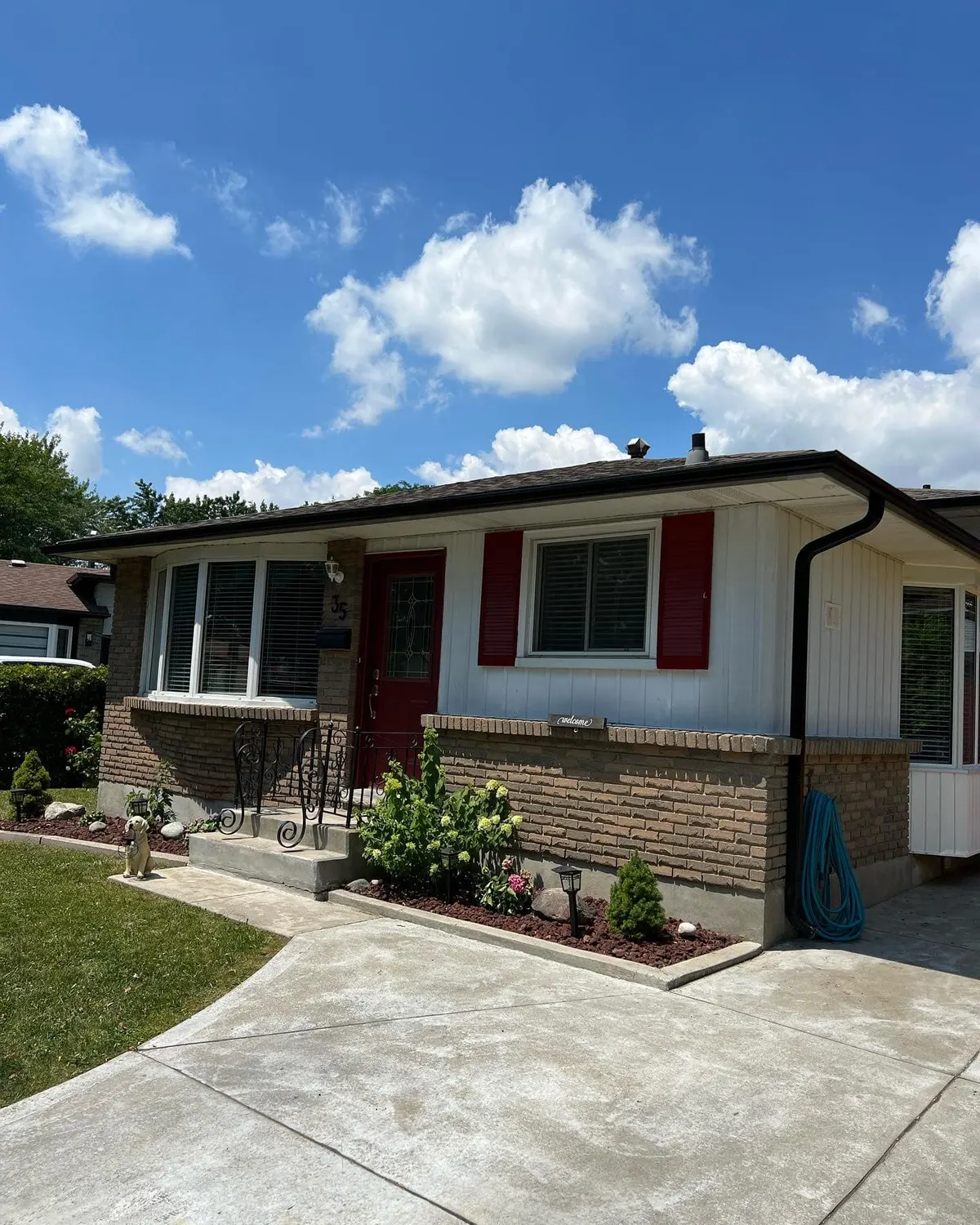
Start with a good install. If you are replacing, this matters more than anything else on the list. Ask how the run will be sloped, how it will be fastened, how the corners are made, and what happens if the fascia is soft when the old eavestrough comes off.
We put up 5-inch seamless eavestrough, formed in our trailer on site to the length of each wall, so there are no joints along the straight runs for a leak to start at. We mitre every corner by hand so it lines up with the run on both sides. We set the slope so water drains to the downspout, and when the board behind the old eavestrough is soft, we replace it before anything new goes up.
Because we make the eavestrough ourselves, there is no manufacturer’s warranty on it. Our 10-year workmanship warranty is the cover, and it applies to every new install and replacement we do. A repair to eavestrough someone else installed is not covered.
Most eavestrough replacements are done in a day. If the soffit or fascia needs replacing too, the job can take a few days to a week, depending on material lead times, and we tell you that when we quote.
Seamless removes the joints along the run, and joints are where eavestrough usually leaks first, so it takes away the most common point of failure. It is not leak-proof: corners, end caps and downspout outlets are still joints, and a seamless run hung flat or on rotted board will fail like any other.
It changes the colour, not the condition. Paint does nothing for a leaking seam, a lost slope or loose fasteners, which are what usually end a run’s life.
We can tell you its condition, which is the honest version of that answer. We will look at the run, the joints, the slope and the board behind it, and tell you whether it needs a repair, a replacement or nothing yet. The quote is free. We serve London, Ingersoll, St. Thomas, Strathroy-Caradoc, Stratford and Aylmer. Call or text (548) 488-3206, or ask for a free quote.
Keep reading


Straight from Google reviews
4.9127 reviews on Google
Read all 127 on Google“Good pricing and great services.”
“Great work! Tibor and Connor did an amazing job. Both were able to answer any concerns. Both very professional. I would highly recommend using Forest City Eavestrough 👌 👍”
“I was extremely impressed with the level of communication, professional information and exceptional work ethic displayed by this team. Work was completed on time and with efficiency. … Definitely would recommend this company and would call them again for any other work.”
“Forest City Eavestrough did a great job replacing our eavestroughs. Tibor gave us a great price, the work was completed in one day … and most importantly, the eavestroughs are functioning perfectly now. Thanks so much!”
“highly Recommend this company, had my eavestroughs replaced and they did a great job!”
“Very happy with the service this team provided. Good pricing, fast service, very responsive. Will definitely hire them again for future jobs.”
“Fantastic experience for us from start to finish! Would highly recommend Forest City Eavestrough to anyone seeking this service.”
“What's an amazing company and crew super fast I called them next day they did all my siding and eavestrough my house looks amazing thanks guys definitely recommend number 1 company thanks again guys”
“I got some eavestrough replaced Excellent work. Great price. Perfect corners,Very easy to deal with and the guys where on time and I had no mess to clean up”
“Kind, considerate, great quality workmanship, professionalism and on time. All important qualities of a trades person. Highly recommend this company.”
Quotes across London and area
Tell us where the house is and what you need. We'll come out, take a look and give you a price.