Serving London & the surrounding area.
EMAIL US
info@fceavestrough.com
CALL US
(548) 488-3206
HOURS
MON - FRI 8AM - 7PM

The short answer
A downspout should empty onto ground that slopes away from your house, far enough out that the water can't run back to the foundation. The City of London suggests about 1.8 m (6 ft). It should never drain against the wall, onto a neighbour's yard, or across a driveway or walkway where it can freeze.
Because a downspout gathers the water from a whole section of roof and lets it out in one spot. In a steady rain, that is a lot of water landing on a patch of ground a few feet across. Where that patch is decides where the water goes next.
If it lands right beside the house, it soaks the soil against your foundation wall. Some of it runs down the outside of the wall, some of it finds cracks and joints, and some of it ends up at the weeping tile around the footing, which then has to carry far more water than it would otherwise. That is how a downspout ends up behind a damp basement, a wet corner after every storm, or a sump pump that runs more than it should.
Over years, soil that is soaked again and again beside the house can wash out or settle. You see it as a low spot along the wall, a patio slab or step that tips toward the house, or a garden bed that keeps sinking. Each of those then holds even more water against the foundation, so the problem feeds itself.
The eavestrough does its job by collecting the water. The downspout only finishes that job if it puts the water somewhere harmless. A well-made run, seamless or sectional, that empties against the wall is moving the problem from the roof edge to the basement.
Out onto open ground that slopes away from the house, and far enough out that it can’t run straight back. The City of London’s flooding page tells homeowners to direct downspouts away from the home, preferably 1.8 m (6 ft), to a spot where the water can be easily absorbed, and to check that the ground around the house slopes away from the foundation wall. That is a sensible target for most houses here.
Grass and garden beds are the best places to land it. They soak water in and slow it down. What you want to see after a rain is water spreading out and disappearing into the lawn, not pooling at the end of the downspout and not running back toward the wall.
Distance only helps if the ground cooperates. A long extension that empties into a low spot, or onto ground that tilts back toward the house, just moves the puddle. Before you settle on a spot, look at which way the yard actually falls, ideally during or right after a rain.
There are four common ways, from a quick fix you can do yourself to a change at the roof edge.
A downspout extension. A length of downspout or flexible pipe added to the bottom elbow to carry the water further out. Hardware stores sell them, and on a house where the eavestrough is sound and the only problem is where the water lands, this may be all you need. The catch is that extensions get stepped on, run over by the lawnmower, and kicked aside, and one that has come loose is back to dumping water at the wall.
A splash pad. A shaped block under the end of the downspout that spreads the water out and stops it digging a hole in the soil. It is useful on its own where the ground already slopes away well, and it pairs well with a short extension. On its own beside the wall, it does not move the water far.
Rerouting. Running the downspout along the wall, around a corner, or under a deck to a spot where the water can drain away properly. This is often the fix when the closest open ground is the wrong ground.
Moving the downspout. Sometimes the outlet itself is in the wrong place, for example where it drops beside a walkway, a door or a patio, and no extension can fix that neatly. Then the downspout is moved to another point on the run so it comes down where the water has somewhere good to go. Moving, extending and rerouting downspouts are part of our eavestrough repair work, so water empties well away from your foundation.
One customer described exactly that kind of job on their own house. Kristi & Chris S. wrote in a Google review: “They also moved my downspout over and ran it under my deck so it empties out much further from my house.”
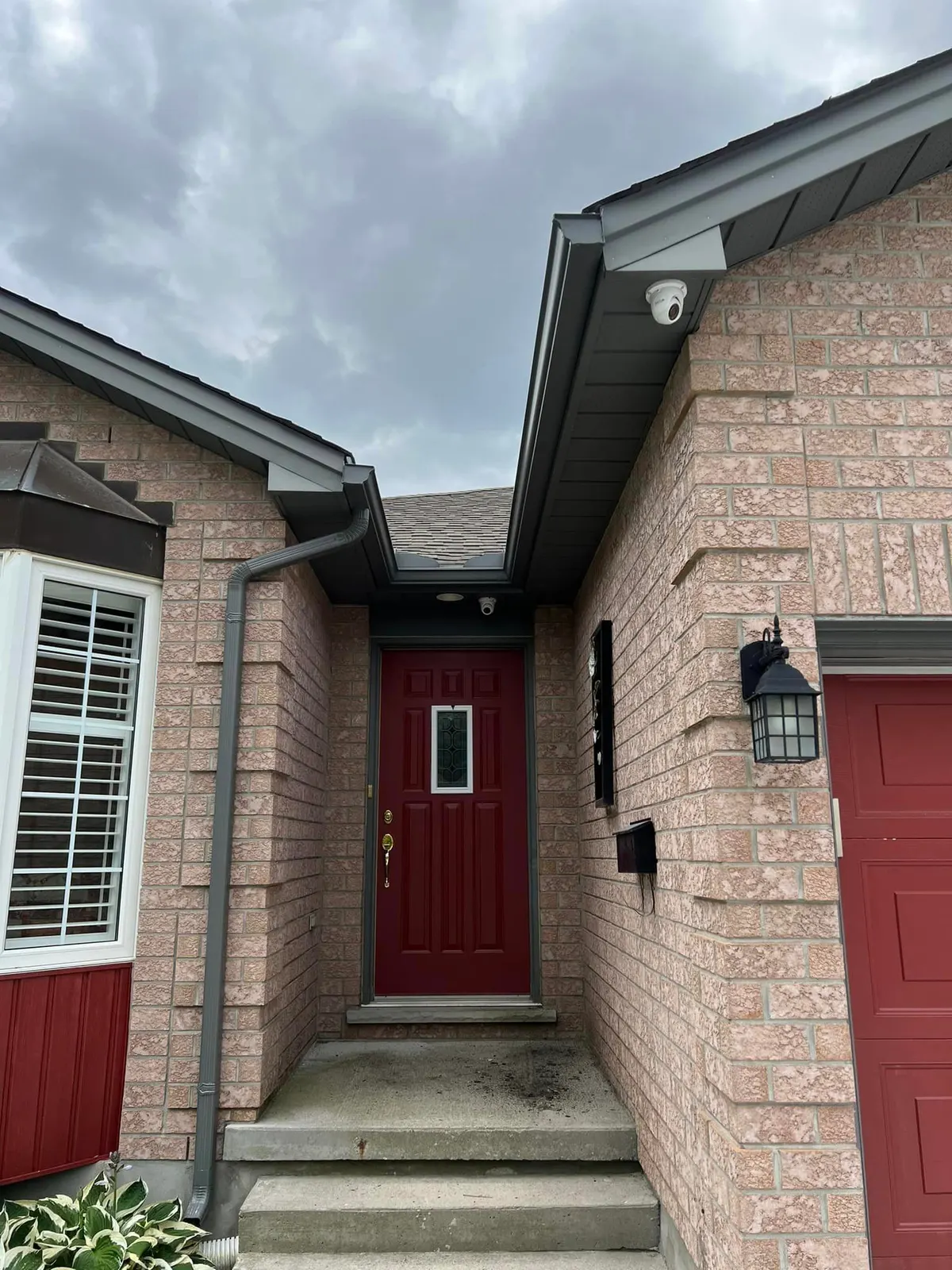
Some spots cause more trouble than the water itself.
Against the wall. A downspout that ends at an elbow right beside the foundation, with nothing to carry the water away, is the easiest problem to fix and one of the most damaging to leave. If the ground there has sunk or the soil looks washed out, it has probably been doing damage for a while.
Onto a neighbour’s yard. Pointing your water at the house next door just hands them the problem. The City’s own downspout advice says the same: send the water away from your home without forcing it onto neighbouring or city property. Its flooding page also notes that a flooding concern between property owners is a civil matter the City can’t step into, so it is far better settled with a downspout pointed somewhere else than with a dispute later.
Across a driveway, walkway or front step. In a London winter, water that crosses a hard surface can freeze into a sheet of ice where people walk. The City gives the same warning for sump pump discharge: not onto a sidewalk or driveway, because the water can freeze. A downspout is no different.
Under a deck, without a plan. Running a downspout under a deck can be the right move, as in the review above, when the pipe carries the water out past the deck to open ground. Letting it empty in the dark under the boards is a different thing. The water sits where it can’t dry, right beside the house, and nobody sees it until something rots or the basement gets damp.
Into a window well. A downspout that empties near a basement window can fill the well and push water in through the window. Make sure the water lands well clear of any window well.
Yes. The City of London’s flooding page says rainwater and groundwater should not enter the sanitary sewer, and tells homeowners to disconnect their downspouts to stay in line with the City’s by-law. It explains why: in heavy rain, weeping tiles connected to the sanitary pipes can overload the sewer and back sewage or stormwater up into homes.
In practice, a downspout that runs into a pipe in the ground, rather than onto the surface, may be connected to the sewer. If you have one of those and aren’t sure where it goes, check with the City before you change anything. Their flooding page also covers lot grading, sump pumps and basement flooding, and it is worth a read if your basement has ever taken on water. The current rules are the City’s to set, and the City is the right place to confirm them.
You need a rainy day and a walk around the house. No ladder.
In winter, look for ice building at the bottom of downspouts, across walkways or on steps. It shows you exactly where the water is going when it’s above freezing. If the ice is up at the roof edge instead, that’s a different problem, and our guide to ice dams and eavestrough covers it.
Take photos of what you find. It makes the conversation with anyone you call much quicker.
When the eavestrough above isn’t getting the water to the downspout in the first place. A run that has sagged or pulled away holds water in a low spot. A run with too few downspouts for the roof above it spills over in heavy rain, and then the water hits the ground right beside the wall no matter where the downspouts empty.
If you see water coming over the front of the eavestrough as well as pooling at the downspouts, look at the whole system before you buy extensions. Our guide on whether to repair or replace your eavestrough walks through how to tell.
If water has been running down behind the eavestrough for a while, check the board it hangs on too. Our guide to rotted fascia and soffit shows the signs.
If you are replacing eavestrough anyway, that is the right time to ask where each downspout should come down, so the new seamless eavestrough empties somewhere that suits the yard, not just where the old downspouts happened to be.
Not unless you know where that pipe goes. In London, the City tells homeowners that rainwater should not go into the sanitary sewer and that downspouts should be disconnected to meet its by-law. If your downspout disappears into the ground and you don’t know where it leads, check with the City before changing it.
Often, yes, if the eavestrough is sound and the ground slopes away where the extension ends. Keep it attached and clear of the lawnmower. If water pools at the end of it or runs back toward the house, the extension isn’t the answer and the downspout may need rerouting or moving.
Yes. We move, extend or reroute downspouts so the water ends up well away from your foundation. If the run itself is the problem, or you wonder whether it needs another downspout, we can look at it and tell you what we see. On an older run, it is worth knowing how long eavestrough lasts before spending money on it.
We work in London and the surrounding area, including Ingersoll, St. Thomas, Strathroy-Caradoc, Stratford and Aylmer. If a downspout is emptying in the wrong place and you’re not sure how to fix it, ask us for a free quote and we’ll look at where the water should go.
Keep reading


Straight from Google reviews
4.9127 reviews on Google
Read all 127 on Google“Good pricing and great services.”
“Great work! Tibor and Connor did an amazing job. Both were able to answer any concerns. Both very professional. I would highly recommend using Forest City Eavestrough 👌 👍”
“I was extremely impressed with the level of communication, professional information and exceptional work ethic displayed by this team. Work was completed on time and with efficiency. … Definitely would recommend this company and would call them again for any other work.”
“Forest City Eavestrough did a great job replacing our eavestroughs. Tibor gave us a great price, the work was completed in one day … and most importantly, the eavestroughs are functioning perfectly now. Thanks so much!”
“highly Recommend this company, had my eavestroughs replaced and they did a great job!”
“Very happy with the service this team provided. Good pricing, fast service, very responsive. Will definitely hire them again for future jobs.”
“Fantastic experience for us from start to finish! Would highly recommend Forest City Eavestrough to anyone seeking this service.”
“What's an amazing company and crew super fast I called them next day they did all my siding and eavestrough my house looks amazing thanks guys definitely recommend number 1 company thanks again guys”
“I got some eavestrough replaced Excellent work. Great price. Perfect corners,Very easy to deal with and the guys where on time and I had no mess to clean up”
“Kind, considerate, great quality workmanship, professionalism and on time. All important qualities of a trades person. Highly recommend this company.”
Quotes across London and area
Tell us where the house is and what you need. We'll come out, take a look and give you a price.