Serving London & the surrounding area.
EMAIL US
info@fceavestrough.com
CALL US
(548) 488-3206
HOURS
MON - FRI 8AM - 7PM

The short answer
Usually it's the eavestrough, not the weather. Overflow in one spot points to a blocked outlet or downspout, a sag, or a roof valley dumping water there. Overflow along a whole run, especially in heavy rain, points to a flat or backwards slope, too few downspouts, or eavestrough too small for the roof above it.
Two questions narrow it down faster than anything else. Does the water come over in one spot, or along the whole run? And does it happen in every rain, or only in a downpour? Put the two answers together and you are most of the way there:
The best time to look is a steady rain. Walk around the house and take a photo or a short video of each spot that spills. It helps whoever comes to look, and it lets you check that what they quote matches what you saw.
Water coming over at one place means the water is being held up at that place.
A blocked outlet or downspout. The outlet is the hole in the bottom of the trough where water drops into the downspout. Leaves, seeds and shingle grit collect there first, and once it plugs, the stretch beside it fills and spills. If the overflow is right next to a downspout, start here.
A sag. A run that has dropped between its fasteners holds water in the low spot instead of draining it, and in a heavy enough rain that low spot is where it comes over. A sag usually leaves standing water behind after the rain stops, too. If a stretch of yours is dipping or pulling away from the house, our guide to sagging or pulling-away eavestrough goes through why it happens.
A corner or an end. Corners collect debris, and an inside corner takes water from two directions at once. If it is always the same corner, that corner is holding water.
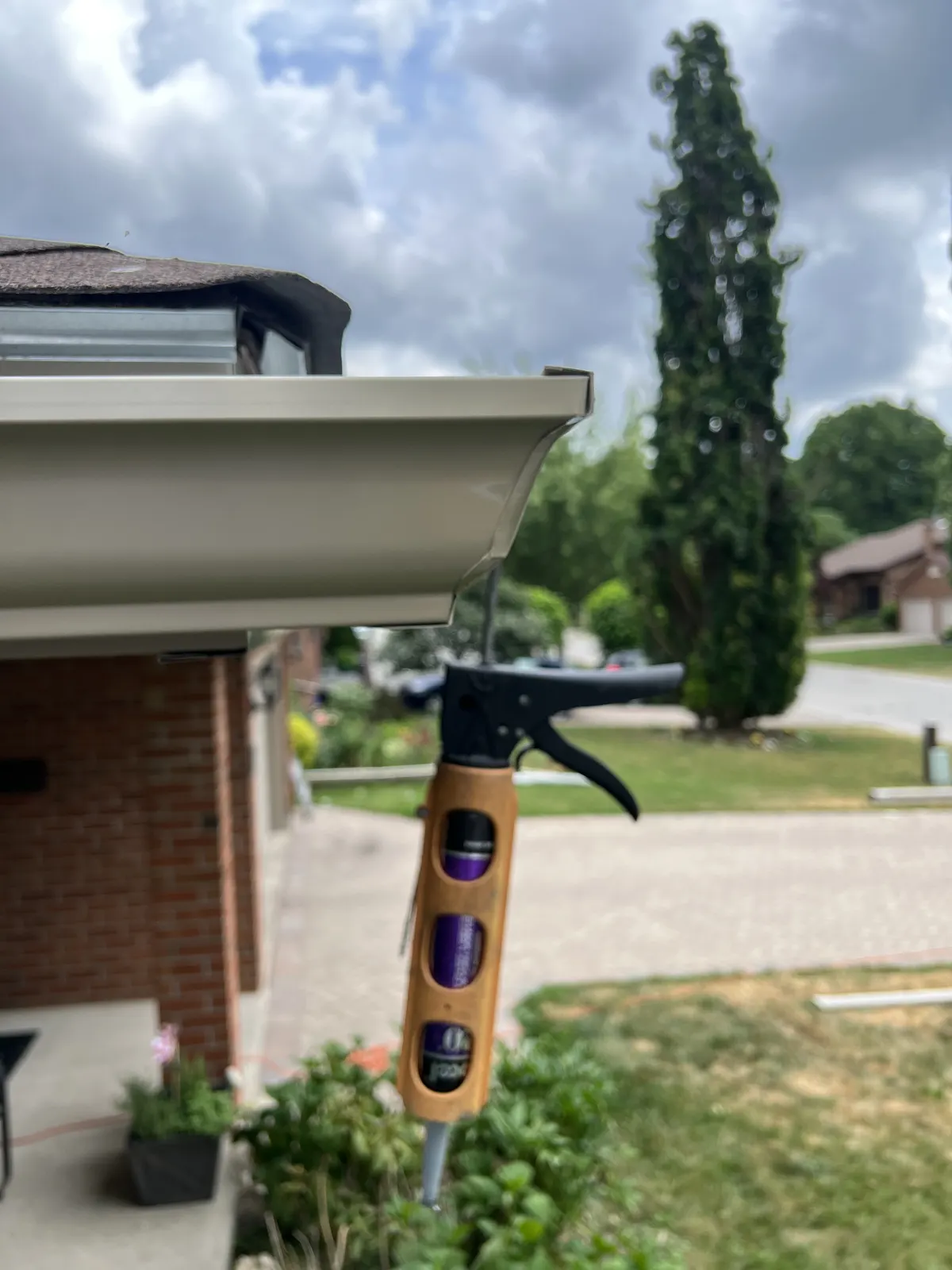
One thing to rule out: a drip is not an overflow. Water dripping from underneath, at a joint or a corner, is a leak. Water coming over the front edge is an overflow. In a downpour the two look the same from the driveway, so stand where you can see the front lip.
When a whole side of the house spills, the problem is the run itself, not one point in it.
Slope. Eavestrough is not hung level. It needs a steady fall toward the downspout so the water runs to the outlet instead of sitting in the trough. A run hung flat, or one that has shifted so it now falls the wrong way, fills along its length and comes over the front. Two giveaways: standing water along the run a day after the rain, and overflow that is worst at the end farthest from the downspout.
Too few downspouts. Each downspout can only carry so much water away. A long run with one downspout at the far end can spill along its length in a heavy rain even when the slope is perfect, because the water reaches the outlet faster than the downspout can take it.
Too small for the roof. A big or steep roof sends more water into the eavestrough, faster, than a small one. If the run is undersized for the roof above it, it overflows in every downpour. More downspouts is often the answer, so each one serves less of the roof. On some roofs, a larger size of eavestrough is.
Debris along the length. Under mature trees, which describes a lot of London, the whole trough can fill, and water runs over the top of the debris instead of along the bottom.
The timing tells you whether something is stopping the water or the eavestrough simply cannot carry it.
Every rain, even a light one. A light rain should never fill a working eavestrough, so overflow in a drizzle means something is in the way: a blockage, a sag or a backwards slope.
Heavy rain only. The eavestrough works, but it is at its limit, from too few downspouts, an undersized run, or a roof valley. A valley is where two roof slopes meet and funnel their water into one short stretch. In a downpour, water comes off a valley fast enough to shoot past the trough or swamp that one section, while the rest of the run copes fine.
Winter. Icicles building along one stretch usually mark where water sits in a low spot or spills over the front. A run full of ice cannot drain at all, so meltwater on a mild day goes straight over the edge. If your trouble is mostly in winter, read our guide to ice dams and eavestrough, because the cause can start on the roof above, not in the trough.
More than you might expect, and none of it needs a ladder. Leave second-storey eavestrough to a crew with the right equipment.
In a steady rain:
On a dry day:
That last check matters more than it looks. Water that spills over the front lands on whatever is below, and water that gets behind the trough soaks the board it hangs on. That board is the fascia, and once it goes soft the fasteners lose their grip, the run sags, and the overflow gets worse. Our guide to the signs of rotted fascia and soffit shows what to look for.
Overflow on its own does not mean new eavestrough. It depends on the cause and the shape of the rest of the run.
These are usually a repair:
These lean toward replacement:
A blocked outlet on an otherwise sound run is neither. That is debris, not a fault in the eavestrough, and it is no reason to replace anything.
We look for the cause first and tell you which it is. If a repair will not hold, we say so before you pay for one. Our page on eavestrough repair in London lists the fixes we do. For the rest of the decision, including age and condition, see whether to repair or replace your eavestrough.
Often not. A guard changes what gets into the eavestrough. It does nothing for a sag, a backwards slope, too few downspouts or a run too small for the roof, and those cause most overflow. Where a valley or a steep roof sheds water fast and heavy, the water can run straight across the guard and over the front.
We are not fans of guards in general, and we would rather fix the cause than cover it. Debris still builds up on a guard, and in a London winter ice can build up in it. If you are weighing one anyway, our guide on whether leaf guards are worth it covers the few cases where one earns its place.
Then the run itself is usually the problem: a sag, a flat or backwards slope, too few downspouts, or a run too small for the roof. Watch where and when it spills to tell which.
An inside corner takes water from two roof slopes at once, often right below a valley. If one corner spills in every heavy rain, more water is arriving there than that stretch can move to a downspout.
Yes, and it is worse than water over the front. Water going behind the eavestrough runs down the board it hangs on and can rot it. If you see staining behind the trough or on the board, have it looked at soon.
Only if the cause is fixed with it. New seamless eavestrough still needs the right slope, enough downspouts and a sound board behind it. A new run hung flat will overflow like the old one.
Yes. When we come out to quote, we look at the slope, the downspouts, the roof above and the board behind the eavestrough, and tell you what is causing the overflow and whether it is a repair. The inspection is free. We serve London, Ingersoll, St. Thomas, Strathroy-Caradoc, Stratford and Aylmer. Call or text (548) 488-3206, or ask for a free quote.
Keep reading


Straight from Google reviews
4.9127 reviews on Google
Read all 127 on Google“Good pricing and great services.”
“Great work! Tibor and Connor did an amazing job. Both were able to answer any concerns. Both very professional. I would highly recommend using Forest City Eavestrough 👌 👍”
“I was extremely impressed with the level of communication, professional information and exceptional work ethic displayed by this team. Work was completed on time and with efficiency. … Definitely would recommend this company and would call them again for any other work.”
“Forest City Eavestrough did a great job replacing our eavestroughs. Tibor gave us a great price, the work was completed in one day … and most importantly, the eavestroughs are functioning perfectly now. Thanks so much!”
“highly Recommend this company, had my eavestroughs replaced and they did a great job!”
“Very happy with the service this team provided. Good pricing, fast service, very responsive. Will definitely hire them again for future jobs.”
“Fantastic experience for us from start to finish! Would highly recommend Forest City Eavestrough to anyone seeking this service.”
“What's an amazing company and crew super fast I called them next day they did all my siding and eavestrough my house looks amazing thanks guys definitely recommend number 1 company thanks again guys”
“I got some eavestrough replaced Excellent work. Great price. Perfect corners,Very easy to deal with and the guys where on time and I had no mess to clean up”
“Kind, considerate, great quality workmanship, professionalism and on time. All important qualities of a trades person. Highly recommend this company.”
Quotes across London and area
Tell us where the house is and what you need. We'll come out, take a look and give you a price.