Serving London & the surrounding area.
EMAIL US
info@fceavestrough.com
CALL US
(548) 488-3206
HOURS
MON - FRI 8AM - 7PM

The short answer
An ice dam is a ridge of ice at the roof edge. Heat escaping from the attic melts snow on the roof, the water runs down and refreezes over the cold eave, and the next melt backs up behind it. Eavestrough is usually the victim, not the cause: the lasting fix is in the attic.
It needs two things: snow on the roof and warmth underneath it. Heat that gets into the attic warms the roof deck from below, and the snow sitting on that part of the roof melts, even on a day that stays below freezing outside.
The meltwater runs down the roof until it reaches the eave, the part of the roof that hangs out past your wall. There is no heated house under the eave, so it stays as cold as the air. The water freezes there. Do that for a few days and the ice builds into a ridge along the edge of the roof: the dam.
The dam is the problem, not the icicles. Once the ridge is there, the next lot of meltwater runs down, hits it and has nowhere to go. It pools behind the ice. Shingles are built to shed water running downhill, not to hold back standing water, so that pool can work its way up under the shingles and into the roof deck, the attic, and sometimes the ceiling or walls below.
A London winter is good at making them. Snow that sits on the roof for weeks, and days that swing around freezing, give the melt-and-refreeze cycle plenty of chances to run.
Because the dam forms on the roof, above the eavestrough, for reasons that start inside the attic. Ice dams form on houses that have no eavestrough at all. Taking yours down would not stop the heat getting into the attic, and it would not stop the snow melting.
That is worth saying plainly, because eavestrough gets blamed for ice dams all the time, and the blame sells a lot of the wrong fixes. New eavestrough on a house that loses heat into the attic will ice up the same way the old one did.
The eavestrough can make things worse, though. A run that has lost its slope holds water in a low spot, and that water freezes in place. A downspout that is clogged or frozen leaves the whole run full. Either way, the eavestrough fills with ice and becomes a solid shelf at the edge of the roof, which gives the dam something to build on. So the honest version is this: the attic causes the dam, and eavestrough that does not drain can help it grow.
This is where the eavestrough pays for a dam it did not cause. After a hard winter, look for these:
A run that has sagged also tends to sag in the same spot every year, because water collects there, freezes, and adds weight where the hangers are already weakest. If yours is already dipping or pulling away, here is what causes eavestrough to sag and what fixes it.
Keeping the roof deck cold, so the snow on it does not melt from below. That is mostly an attic job, and we would rather tell you that than sell you eavestrough to fix it.
Attic insulation and air sealing. This is the root fix. Warm air leaking up from the house through gaps around light fixtures, the attic hatch, plumbing and wiring carries a lot of heat with it, and too little insulation lets more through. An insulation contractor or an energy auditor can tell you where your attic is losing heat. It is not our trade, and it is the part that matters most.
Attic ventilation. A ventilated attic draws cold outside air in low, through the soffit, and lets it out high, through vents at or near the ridge. That moving air keeps the underside of the roof close to the outside temperature. If the vents are missing, too few, or blocked, the attic runs warmer. The roof vents and the baffles that keep insulation clear of the soffit are a roofer’s or an insulator’s job.
Soffit that lets air in. The intake half of that airflow comes through the soffit under your roof overhang. Soffit can be vented or solid, and vented soffit only helps if the air path behind it is open. A stretch of solid panel, or insulation stuffed against the back of a vented one, starves the attic of air. If your soffit is due for replacement, it is the moment to check which parts of the overhang should be vented; our guide to vented vs solid soffit covers how to tell.
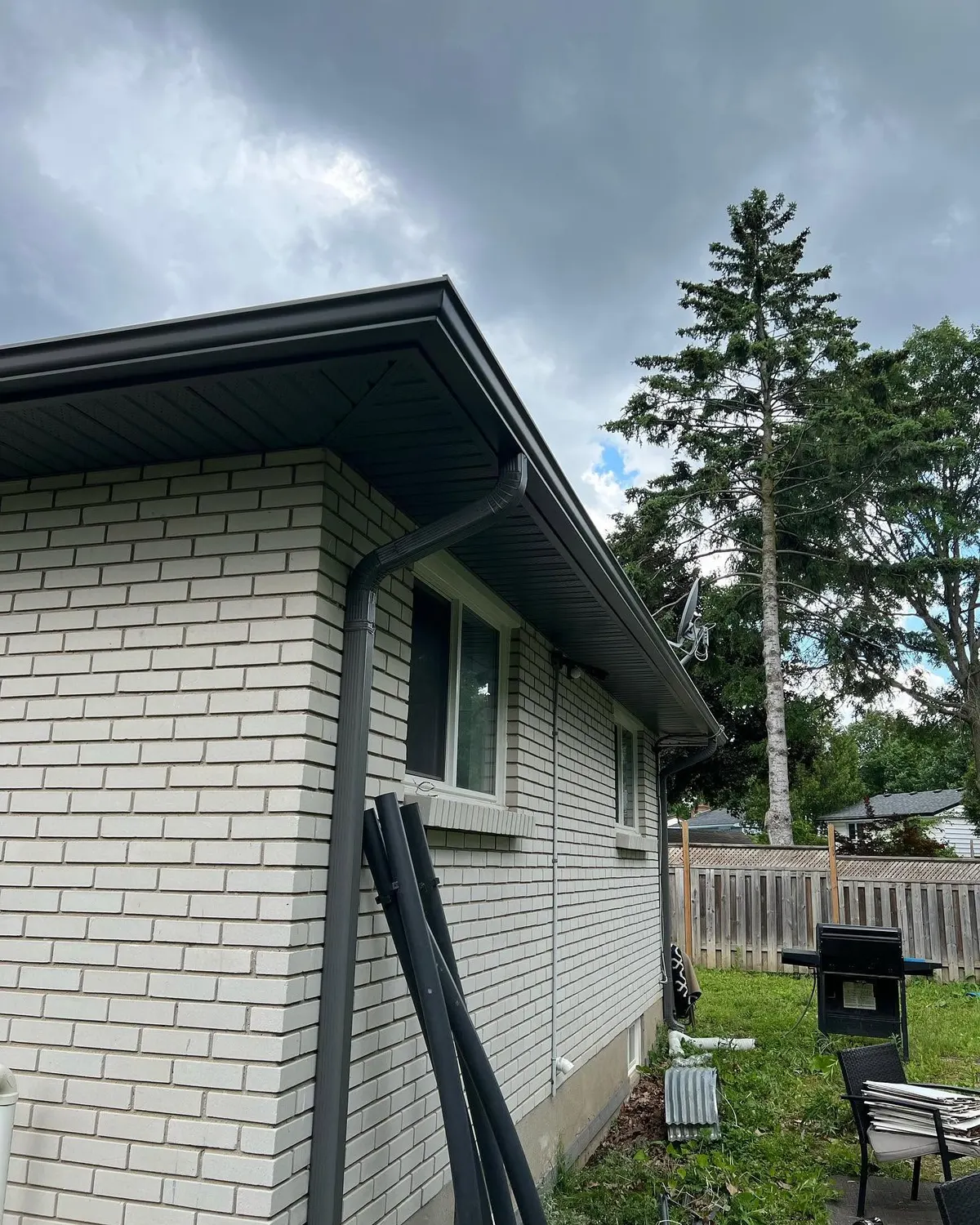
Eavestrough that drains. This is the part we do. A run set to the right slope, with downspouts that are clear and in the right places, does not hold standing water to freeze. It will not stop an ice dam caused by the attic, but it stops the eavestrough from adding to it, and it means the spring melt goes where it should. Where that water lands matters as well: see where your downspouts should drain.
On the roof itself, roofers lay a waterproof membrane under the shingles along the eave, often called eave protection or ice and water shield, so that water pooling behind a dam has a second barrier. Whether yours has it is a question for a roofer.
A lot of ice dam damage is done by trying to get rid of the ice in a hurry. Avoid these:
What is safe: clearing the lower few feet of snow off the roof from the ground with a roof rake, gently, so you are not dragging it hard across the shingles, and staying well clear of power lines. Less snow at the edge means less to melt. If water is already coming inside, call a roofer rather than going up yourself.
Heat cables laid along the eave are sold for this. They can keep a channel open for meltwater, but they treat the ice, not the heat loss causing it, and they need power and care to install safely. Ask whoever installs them how they attach without damaging the shingles or the eavestrough.
It depends on where the damage is, so it helps to know whose trade each part is.
Water inside the house. Stains on the ceiling or upper walls, or drips in the attic, mean water is getting under the shingles. That is a roofer first, and then an insulator to deal with the heat loss behind it.
Eavestrough bent, sagging, leaking or pulling away after the thaw. That is us. We look at the whole run, find whether it is a hanger, a section, the slope or the board behind it, and tell you whether it is an eavestrough repair or a replacement.
If the damage is a few sections on otherwise sound eavestrough, a repair is usually the right spend; our guide on whether to repair or replace your eavestrough shows how to tell.
Fascia that is stained, soft or crumbling. Also us. The board usually cannot be replaced with the eavestrough still in place, so the eavestrough comes down, the fascia is replaced, and the run goes back up or is replaced. See how we handle soffit and fascia repair.
The same ice dam, every winter, in the same spot. That is the attic telling you where it loses heat. Fixing the eavestrough will fix the damage, but the dam will come back until the attic is sorted.
If your eavestrough took a beating last winter, ask us to take a look. The inspection and the quote are free, and if the cause is in the attic or the roof, we will say so.
No. New eavestrough that drains properly stops the run from adding to the ice and fixes the damage last winter did, but the dam itself comes from heat in the attic. Replace the eavestrough without dealing with that, and the new run ices up the same way.
Not always. A few icicles are normal. A thick ridge of ice along the roof edge with icicles hanging off it, or icicles that build in the same stretch every year, point to heat loss above, or to a run that is holding water in a sag.
Yes. Ice puts weight on any eavestrough, seamless or sectional, and enough of it can pull a run away from the fascia or bend the front edge. Seamless has no joints along the run, so there are fewer seams for ice to open up. Here is how seamless compares with sectional.
We work in London and the surrounding area, including Ingersoll, St. Thomas, Strathroy-Caradoc, Stratford and Aylmer. If you are nearby but not on that list, call and ask.
Keep reading


Straight from Google reviews
4.9127 reviews on Google
Read all 127 on Google“Good pricing and great services.”
“Great work! Tibor and Connor did an amazing job. Both were able to answer any concerns. Both very professional. I would highly recommend using Forest City Eavestrough 👌 👍”
“I was extremely impressed with the level of communication, professional information and exceptional work ethic displayed by this team. Work was completed on time and with efficiency. … Definitely would recommend this company and would call them again for any other work.”
“Forest City Eavestrough did a great job replacing our eavestroughs. Tibor gave us a great price, the work was completed in one day … and most importantly, the eavestroughs are functioning perfectly now. Thanks so much!”
“highly Recommend this company, had my eavestroughs replaced and they did a great job!”
“Very happy with the service this team provided. Good pricing, fast service, very responsive. Will definitely hire them again for future jobs.”
“Fantastic experience for us from start to finish! Would highly recommend Forest City Eavestrough to anyone seeking this service.”
“What's an amazing company and crew super fast I called them next day they did all my siding and eavestrough my house looks amazing thanks guys definitely recommend number 1 company thanks again guys”
“I got some eavestrough replaced Excellent work. Great price. Perfect corners,Very easy to deal with and the guys where on time and I had no mess to clean up”
“Kind, considerate, great quality workmanship, professionalism and on time. All important qualities of a trades person. Highly recommend this company.”
Quotes across London and area
Tell us where the house is and what you need. We'll come out, take a look and give you a price.